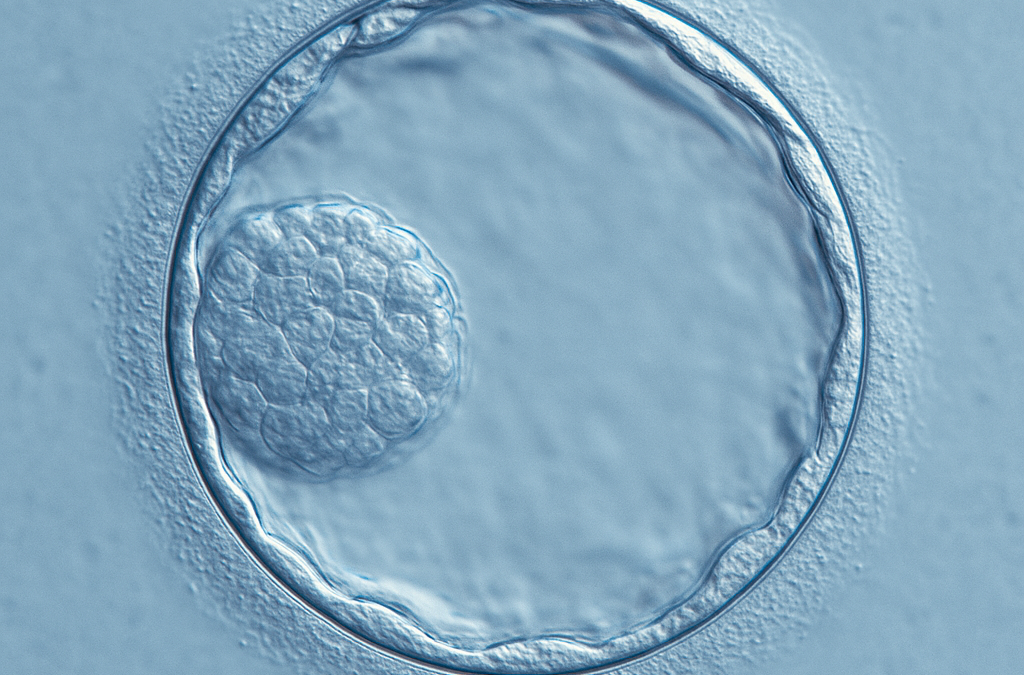
The blastocyst is one of the most important stages in the early development of a human embryo. It forms around the fifth or sixth day after fertilisation, by which time the embryo has already undergone several cell divisions and has developed a more complex and specialised structure.
In the first few days following fertilisation, the embryo divides into two, four, eight cells and so on. When it reaches around 100 cells, it develops into a blastocyst. At this stage, the embryo is no longer just a collection of cells, but has begun to organise itself internally.
The blastocyst consists of two main parts:
• The inner cell mass: a small group of cells from which the future baby will develop.
• The trophoectoderm: an outer layer of cells that will form part of the placenta.
Furthermore, a fluid-filled cavity called the blastocoel forms inside the blastocyst, giving it its characteristic ‘hollow sphere’ shape.
This stage is crucial because it is at this point that the embryo prepares to implant itself in the uterus, thereby officially marking the start of the pregnancy.
In assisted reproduction treatments, such as in vitro fertilisation (IVF), blastocysts are usually transferred to the uterus at this stage, as this is when they have the greatest capacity for implantation. It is also the optimal stage for carrying out genetic testing prior to transfer or for cryopreserving them via vitrification.
In summary, the blastocyst is an indication that embryonic development is proceeding normally, and its formation marks a key milestone on the path to a successful pregnancy.
Daniel García
Embriologist
What is a blastocyst?